
The 3-Part Marketing System Every Small Business Needs
How every small business can attract, engage, and convert with more clarity — without doing everything everywhere all at once
There is a point where marketing can start to feel like a room full of open tabs.
One tab says you need to post more. Another says you need better SEO. Another says email is the answer. Someone else says video is everything. Then AI walks in and says it can help you create all of it faster — which sounds wonderful until you realize faster is not always the same thing as clearer.
And that is where so many small business owners find themselves right now.
Busy, visible, trying hard… but still not quite sure if all the effort is adding up to anything.
I see this all the time. A business owner is posting on social media, sending the occasional email, refreshing their website, trying to keep up with content, thinking about ads, wondering if they should be on TikTok, LinkedIn, YouTube, or all of the above. All while trying to attract clients and sell products! The small business owner is doing a lot, but the pieces are not always connected.
And when the pieces are not connected, marketing starts to feel heavier than it should.
That is why simple frameworks matter.
Not because they make marketing magical. Not because they remove the work. But because they give the work a place to go.
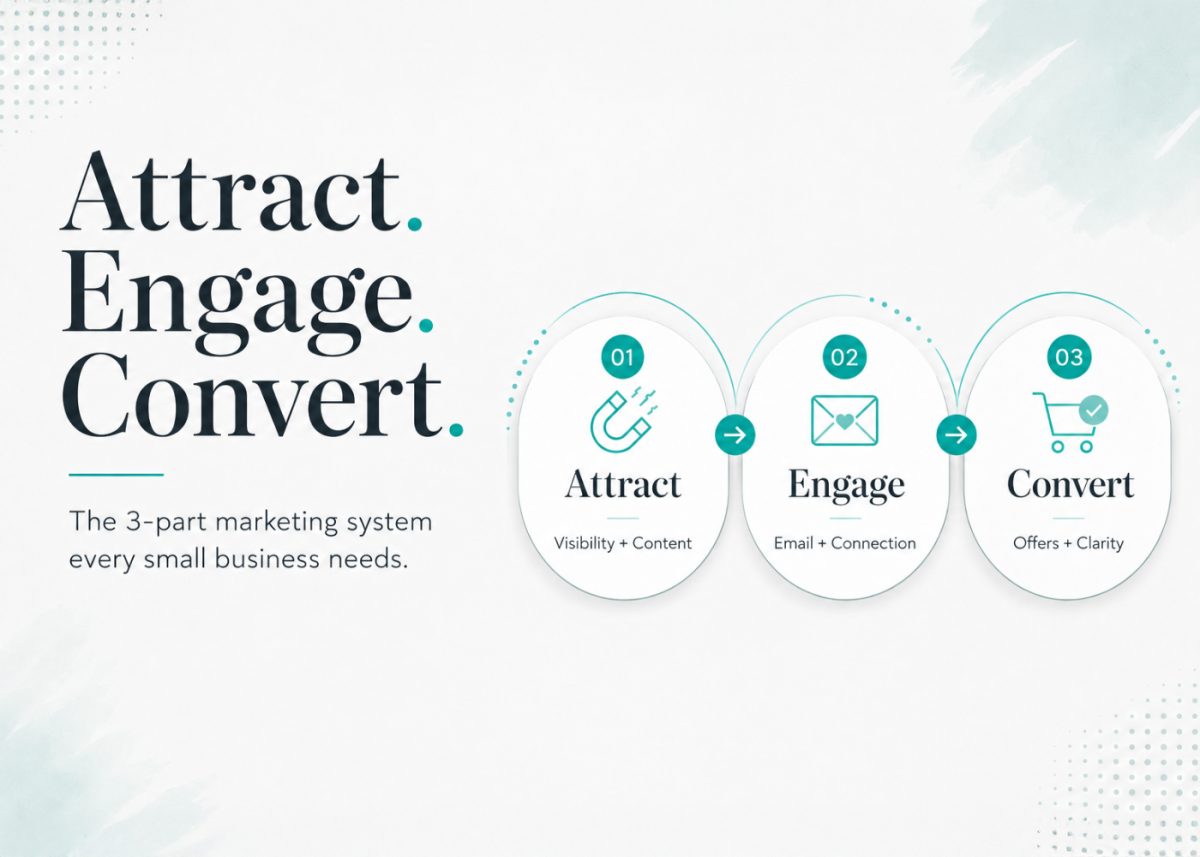
I believe every small business needs a simple, balanced marketing system built around three things:
Attract. Engage. Convert.
That’s it.
Not because those are the only three things marketing can do, but because almost everything you are trying to accomplish fits somewhere inside that system. And when one of those pieces is missing, momentum starts to leak.
Why Marketing Feels So Scattered Right Now
Marketing has become incredibly accessible. That is the good news.
You can create a post, send an email, build a landing page, run an ad, record a video, write a blog, or design a graphic from your laptop with tools that did not exist in this form even a few years ago.
But accessibility for the small business owner has also created a different kind of problem.
Because now that we can do so many things, we start to feel like we should do all of them.
The pressure is constant. Be visible. Be consistent. Be helpful. Be educational. Be entertaining. Be personal. Be strategic. Be everywhere your audience might be.
Even for a large team, that is a lot!
For a solopreneur, consultant, creative business owner, or small team, it can become exhausting very quickly.
The answer is not to do more random marketing. The answer is to build a simple system where every piece has a purpose.
That is where the Attract, Engage, Convert framework becomes so helpful.
Part One: Attract
Attract is about visibility.
This is the part of your marketing that helps people discover your small business and begin to understand what you do.
Attraction can happen through social media, blog content, SEO, referrals, speaking, podcast interviews, local networking, paid ads, videos, lead magnets, or search. The channel may change depending on your business, but the purpose is the same.
You are helping the right people become aware that you exist.
But here is where many businesses get tripped up: they confuse visibility with volume.
They think attraction means posting constantly or showing up on every platform. But attracting the right people is not just about being seen. It is about being seen clearly.
If your content is visible but your message is vague, people may notice you but not understand why they should care.
That is why attraction begins with clarity. Your audience needs to know who you serve, what problem you help solve, and why your work matters. Otherwise, you are simply adding more content to an already crowded room.
A strong attraction strategy might look like a weekly blog article, two or three thoughtful social posts, a simple lead magnet, or a consistent LinkedIn presence. It does not have to be complicated. It just has to be intentional.
The question to ask is:
How are the right people finding my small business?
If you cannot answer that clearly, your attraction system needs attention.
Part Two: Engage
Engage is about relationship.
This is the part many businesses underestimate, because it is less flashy than visibility and less obvious than conversion. But engagement is where trust begins to grow.
People rarely move from stranger to client in one step. They need a little time. They need to hear your voice more than once. They need to see how you think, how you respond, what you value, and whether your approach feels aligned with what they need.
Engagement happens when someone reads your email, replies to a post, downloads your guide, comments on LinkedIn, sends you a message, watches your video, or simply keeps showing up quietly in the background until one day they are ready.
This is why email still matters.
Social media is wonderful for visibility and conversation, but email gives you a more direct line of communication with people who have already raised their hand in some way. It allows you to nurture the relationship, share your thinking, offer value, and stay present without relying completely on algorithms.
Engagement is also where your humanity matters most. Your audience does not just need information from you. They need context. Perspective. Encouragement. A reason to trust your way of seeing the problem.
This is where your brand voice, stories, examples, insights, and lived experience begin to do their quiet work.
The question to ask is:
How are you staying connected to the people who have already shown interest in your small business?
If people find you but never hear from you again, momentum slips away.
Part Three: Convert
Convert is about the next step.
This is where your marketing needs to make it clear what someone should do if they are ready to move forward.
For some businesses, that next step might be booking a consultation. For others, it might be downloading a guide, joining a newsletter, purchasing a product, requesting a quote, visiting a showroom, signing up for a webinar, or sending a direct message.
The conversion step does not have to be aggressive. In fact, it should not feel forced. But it does need to be clear.
This is where many thoughtful business owners get uncomfortable. They do the work of attracting and engaging, but then they hesitate when it is time to invite people into the next step. They do not want to sound pushy. They do not want to overdo the selling. They assume people will know what to do.
But most people need to be guided.
A clear call to action is not pressure. It is service.
It says, “If this is where you are, here is how I can help.”
Conversion depends on clarity. Your offer needs to make sense. Your messaging needs to be simple. Your audience needs to understand what happens next and why it matters.
The question to ask is:
Are you making it easy for interested people to take the next step?
If the answer is no, you may be creating interest without creating movement.
Why Most Small Businesses Are Missing One Piece
When marketing is not working, it is usually because one of these three parts is weak, missing, or disconnected.
Some businesses are good at attracting attention, but they do not nurture the relationship. They get views, likes, clicks, or traffic, but very little follow-through.
Some are good at engaging. They have warm relationships, loyal followers, and good conversations, but they do not have a clear offer or call to action.
Others are ready to sell, but they have not built enough visibility or trust. They are asking people to take action before the relationship has been developed.
This is why marketing can feel so frustrating.
You may be doing many things correctly, but if the system is out of balance, the results will feel inconsistent.
Attract without engage can feel shallow.
Engage without convert can feel warm but stagnant.
Convert without attract can feel like shouting into an empty room.
A healthy marketing system needs all three.
Not perfectly. Not all at once. Not in some overbuilt, complicated way. But enough that your audience can move naturally from awareness to trust to action.
What a Balanced Marketing System Looks Like
A balanced marketing system for your small business does not have to be massive. It simply needs to be connected.
For example, you might attract people through a weekly blog and LinkedIn posts. You might engage them through email, comments, conversations, and helpful follow-up content. You might convert them through a clear guide, consultation offer, service page, or invitation to talk.
That is a system.
Simple. Human. Repeatable.
The mistake is thinking every part of marketing has to be reinvented every week. It does not. In fact, the best systems are usually built from repeatable rhythms.
One piece of long-form content can become several social posts. One guide can become a landing page, an email sequence, a blog CTA, and a conversation starter. One core idea can move through multiple channels when it is rooted in a clear strategy.
That is what makes marketing sustainable.
You are not waking up every day asking, “What should I post?”
You are building a structure that helps your message keep moving.
Introducing the 7-Day SPARK Plan
This is exactly why I created the SHC Client Spark Plan.
After finishing the Creative CEO Quick Start Marketing Guide, I wanted the next step to be practical. Because clarity matters, but clarity needs movement.
The guide helps you understand where to begin.
The SPARK Plan helps you take action.
It is a simple 7-day framework designed to help small business owners, solopreneurs, consultants, creatives, and entrepreneurs create momentum around attracting new clients.
Each day focuses on one part of the process — getting clear, becoming visible, building authority, creating connection, inviting the next step, and then turning that activity into a repeatable rhythm.
This is not about doing everything everywhere.
It is about doing the right things in the right order.
And that is the difference.
How SPARK Fits Into Attract, Engage, Convert
The SPARK Plan works because it brings the system to life in a simple, manageable way.
It helps you attract by clarifying your message and showing up where your audience is already paying attention.
It helps you engage by creating content and conversations that build trust instead of simply filling space.
And it helps you convert by making sure every effort has a clear next step.
Because marketing should not feel like a pile of disconnected tasks. It should feel like a path.
A path your audience can follow. A path that helps them understand who you are, why your work matters, and how to take the next step when they are ready.
The Real Goal: Momentum You Can Repeat
The goal is not to create a one-week burst of activity and then disappear.
The goal is to learn the rhythm.
When you understand how attract, engage, and convert work together, you can repeat the process again and again. You can adjust it for your industry, your audience, your offer, your season, and your capacity.
That is especially important for small business owners.
You do not need a giant marketing department to build momentum. You need a clear message, a focused set of channels, useful content, real engagement, and a simple way for people to say yes.
That is where growth begins to feel less mysterious.
Not easy. Not instant. But clearer.
And clearer is powerful.
Where to Start This Week
If your marketing feels scattered, start by looking at the system.
Ask yourself:
Attract: How are the right people finding me?
Engage: How am I staying connected and building trust?
Convert: How am I inviting people to take the next step?
You may not need to overhaul everything, you may simply need to strengthen the piece that is missing.
Maybe you need better visibility. Maybe you need a stronger email rhythm. Maybe your call to action needs to be clearer. Maybe your offer needs to be simplified. Maybe your content needs to lead somewhere instead of floating out into the world with no real destination.
Start there.
Small changes in the right place can create real momentum.
Ready for a Clearer Marketing System?
At Sandy Hibbard Creative, this is the work I love helping businesses build: clear strategy, strong messaging, and content systems that feel human, manageable, and connected.
Because marketing does not have to feel like a hundred open tabs.
It can be simpler than that. It can have structure, rhythm, and a clear next step.
Start with the Creative CEO Quick Start Marketing Guide if you need clarity around your message and direction.
Then move into the SHC Client Spark Plan when you are ready to turn that clarity into action and start creating momentum.
The goal is not to do more marketing.
The goal is to build a system that works.
And when your marketing has a system, it finally has somewhere to go.