
MARKETING MOVES
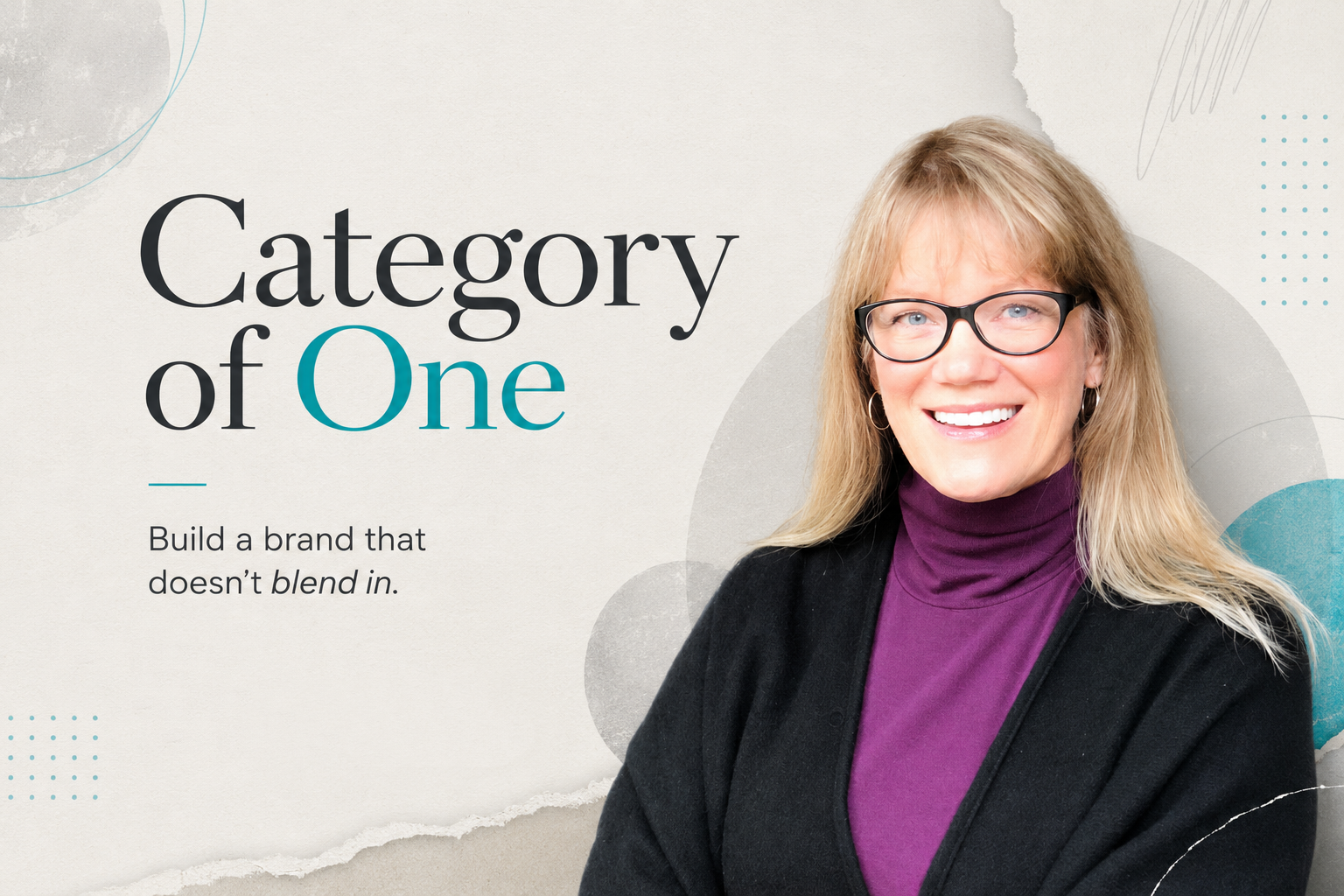
Define Your Category of One: Why Your Brand Was Not Meant to Blend In
Why clarity, conviction, and your own lived experience may be the strongest marketing advantage you have
There comes a moment in business when you realize you cannot keep building your brand by looking sideways. You have to look ahead, right straight into you.
After 26 years of working with clients to build their brand, rebrand their brand, discover their voice, map a path to their story, and everything else in between – I have found that when it comes down to “branding”, it’s starts with you.
Measuring your message against what everyone else is saying doesn’t work. You cannot keep reshaping your voice to fit the latest trend, the latest template, or the latest version of what seems to be working online. At some point, you have to come back to yourself.
Circling back to what you know, who you serve best, and what feels true and authentic, that’s where a strong brand begins.
It’s not in comparison or imitation, or giving it a quick polish, strong brands begin with clarity. And one of the clearest things you can do for your business is define what I like to call your category of one.
Because you were not born to blend in! 😉
What It Means to Define Your Category of One
Defining your category of one is not about pretending no one else does what you do.
Of course other people do what you do. And many other companies offer what you do, using the same tools, and maybe even doing it better! That is true in almost every industry.
But no one brings your exact combination of experience, perspective, personality, values, instincts, relationships, creativity, and lived wisdom to the work.
That is the difference.
Your category of one is the space where your expertise, your audience, your values, and your transformation all come together in a way that feels unmistakably yours.
It is the difference between saying:
“I offer marketing services.”
And saying:
“I help creative-driven businesses clarify their message, strengthen their voice, and build marketing that feels human, strategic, and true to who they are.”
One tells people what you do.
The other helps them understand why it matters.
There Is No Prize for Being a Cheaper Version of Someone Else
One of the easiest traps in business is comparison.
We look around and see what others are charging, how they are packaging their services, what they are posting, how they are describing themselves, and how often they seem to be showing up. Then, almost without realizing it, we start adjusting ourselves.
Maybe we lower the price. Maybe we broaden the offer. Maybe we soften the message. Maybe we try to sound more like “the market” and less like ourselves.
But there is no real prize for becoming a cheaper or more convenient version of someone else.
That kind of positioning might get a little attention for a moment, but it rarely builds lasting trust. It puts you in the comparison lane, where people are weighing you against someone else based on price, speed, deliverables, or surface-level details.
And once you are in that lane, it is hard to feel valued.
A category of one moves you out of that race.
It helps people understand not just what you offer, but why your way of seeing, solving, creating, guiding, or building is different.
That is when your audience stops comparing quite so much.
When You Blend In, You Become Forgettable
One of the biggest dangers in modern marketing is not always failure. Sometimes it is sameness.
Sameness can look very professional. It can have nice graphics, polished captions, clean websites, and all the right buzzwords. From the outside, it may look like everything is working.
But underneath it, there may be very little that feels distinct.
The message could belong to almost anyone. The words could be swapped with a competitor’s. The content may be useful, but not memorable. The brand may be visible, but not felt.
That is what happens when we sand down too many of our edges.
We use safe language because we do not want to sound too bold. We try to speak to everyone because we do not want to miss an opportunity. We stay broad because narrowing feels risky. We follow what others are doing because it feels more secure than trusting our own point of view.
But the brands people remember are usually not the ones that sound the safest.
They are the ones that feel clear.
They have a point of view. They have a presence. They have a certain way of saying things, solving things, or making people feel. You may not even be able to explain it at first, but you know when a brand has a real identity behind it.
And your audience knows it too.
People can feel when you are leading from identity instead of insecurity.
They can feel when your words come from lived experience instead of borrowed language. They can feel when you know who you are and who you are here to serve.
That kind of clarity builds trust.
And in business, trust is not a soft thing. Trust is currency.
Your Brand Needs More Than a Service List
Trust – having it or earning it – is not just a feeling; it is showing up in the larger marketing conversation too. HubSpot’s 2026 State of Marketing Report points to brand point of view as a growth driver in a marketplace increasingly flooded with AI-generated content. Edelman’s brand trust research also reinforces that trust is earned through relevance, responsiveness, and clear action — and that trusted brands are more likely to earn purchase, loyalty, and advocacy. In other words, clarity is not just creative. It is strategic. A lot of businesses can explain what they do.
A strong brand answers the quieter questions your audience is already asking:
Do you understand me?
Do you see the problem clearly?
Do I trust your approach?
Do you believe what you are saying?
Can you help me get where I want to go?
That is why your category of one matters.
It gives your brand a point of view. It gives your marketing a center of gravity. It helps your audience place you in their mind in a way that feels simple and meaningful.
Without that, marketing becomes scattered. You post because you feel like you should. You change your message depending on what competitors are doing. You try to keep up with trends. You say too much because you are not quite sure what matters most.
But when your category becomes clear, your marketing starts to become focused and settled.
That kind of clarity is freeing.
The Category of One Formula
A simple way to begin defining your category of one is to bring together three essential pieces:
Who you are + who you serve + the transformation you deliver = your category of one
This is not meant to be a stiff corporate positioning statement. It is simply a way to organize your truth.
Start with what you know about yourself and your work.
Who are you, really, in the way you serve people? Are you a guide, a strategist, a teacher, a connector, a designer, a storyteller, a problem-solver, a builder, a healer, a creative director, a trusted advisor?
Then ask who you serve best. Not everyone. The right ones. The people who truly benefit from your way of working.
Then name the transformation. What changes because of you? What becomes clearer, easier, stronger, more beautiful, more profitable, more peaceful, more possible?
Put those pieces together.
For example:
I help creative-driven businesses build unforgettable brands through authentic storytelling, sharp strategy, and modern media.
Or, in my own world, I often think of it this way:
I help businesses find the clarity, voice, and creative direction they need to attract the right clients and grow with confidence.
That may not sound like a traditional agency statement, but it is the heart of the work. It says something about who I am, who I serve, and what matters to me.
And that is what your category of one should do.
It should not just describe your work. It should reveal something true about the way you do it.
How I Found My Own Lane
When I bought my first agency, I did not have a perfect roadmap.
I had vision, grit, and a deep belief that I could help people brand and grow their business. I could see things in people, in their businesses and in the culture and time that oftentimes they could not see themselves.
There were plenty of other competitors selling campaigns, ads, graphic design, websites, and tactics, templates, programs, systems and courses. And of course, all of those things matter. But I always knew the work went deeper than that. That first you had to have a clear vision about who you were and what you were offering.
I was never just interested in making something look good. I wanted to help people become clear. Clear about who they were and how their business was positioned. Clear about what they offered. Clear about why their work mattered and how to communicate that in a way people could feel and understand. If you know that, my job as a marketer becomes easier!
Over time, that became my lane, helping people find the words, strategy, and creative direction that made their business feel more like themselves.
That is what good marketing does at its best. It does not just package a business, it reveals it.
You Are Not Just Selling Deliverables
This is especially important for service-based businesses, consultants, creatives, experts, and entrepreneurs.
It is easy to think people are only buying the tangible thing. The website. The session. The package. The consultation. The room design. The listing presentation. The coaching program. The event. The product.
But most of the time, people are buying something more meaningful than the thing itself.
They are buying confidence. Relief. Direction. Beauty. Belonging. Momentum. Trust. A sense that someone finally understands what they have been trying to say, solve, create, or become.
That is why your category of one has to reach beyond the deliverable.
A designer is not just selling rooms. She may be creating spaces that help people feel peaceful, inspired, and connected to their own lives.
A realtor is not just selling houses. She may be guiding people through one of the biggest transitions of their lives with clarity, confidence, and care.
A consultant is not just selling advice. He may be helping leaders move from confusion into focused action.
An artist is not just selling objects. She may be offering beauty, memory, story, and self-expression.
A marketing strategist is not just selling content. She may be helping a business finally sound like itself.
The deliverable matters. But the transformation is what people remember.
That is where your category begins to take shape.
Three Questions to Help You Find Your Category of One
If you are not sure where to begin, do not start by trying to write the perfect statement. Start by listening to what you already know.
1. What do you know from lived experience that others may not?
Your lived experience gives your work depth. It is the part of your expertise that cannot be quickly copied because it was earned over time.
What have you learned the hard way? What do you understand because you have been in the field long enough to see the patterns? What do people come to you for because you simply “get it”?
This is often where your strongest positioning begins.
2. Who do you serve exceptionally well?
Not everyone.
The right ones.
This is where many business owners get nervous because narrowing can feel like losing opportunity. But more often, clarity creates opportunity. When you are specific about who you serve best, the right people recognize themselves faster.
You do not need to be the answer for everyone.
You need to be unmistakably valuable to the people you are best equipped to help.
3. What transformation do you deliver?
Look beyond the task.
What changes because of your work? What becomes clearer, stronger, easier, more beautiful, more profitable, more peaceful, or more possible?
How do people feel after they work with you? What do they understand, believe, create, decide, or do differently?
That transformation is not a side note.
It is part of your value.
Define Your Category of One: How You Can Take Action
This week, write your Category of One statement.
You can begin with one of these simple formulas:
I help ________ solve ________ so they can ________.
Or:
I help ________ become/do/achieve ________ through ________.
Do not worry about making it perfect. Write it raw first. Let it be a little messy. Let it tell the truth before you try to make it sound polished.
Then say it out loud every morning this week.
Listen to it. Notice where it feels too soft, too broad, or too generic. Notice where it gives you energy. Notice where it makes you a little nervous.
If it feels too soft, sharpen it. If it feels too broad, narrow it. If it feels a little scary, you may be close.
Because real positioning often does feel bold at first. It asks you to stop hiding behind general language and start claiming the value you actually bring.
You are not shrinking to fit the market.
You are building a space where the right people can find you.
This Is Where Strong Marketing Begins
Defining your category of one is not a small branding exercise. It is the beginning of clearer marketing.
It affects your website. Your social media. Your email content. Your offers. Your sales conversations. Your client experience. Your confidence. Your ability to say yes to the right work and no to what no longer fits.
When you know your category, you stop throwing content into the wind and hoping something lands. You begin creating from a center. You begin speaking from a place of identity instead of reaction.
That is what makes marketing feel less scattered and makes your message stronger.
In a world where so much content is starting to sound the same, a clear, honest, human point of view may be one of the most powerful advantages you have.
You were not born to blend in.
You were not meant to sound like everyone else.
Define your category of one.
Then build from there.
Ready to Clarify Your Brand?
If your marketing feels scattered, inconsistent, or harder than it should be, the problem may not be your effort. It may be your positioning.
At Sandy Hibbard Creative, I help businesses clarify their message, define their category of one, and build marketing that reflects who they truly are — with strategy, creativity, and a voice that connects.
Download the free Creative CEO Quick Start Marketing Guide to start bringing clarity, focus, and momentum back into your marketing.
And if you are ready for deeper support, let’s talk about how to shape a strategy that fits your business, your voice, and where you want to go next.